

The 3 Biggest Misconceptions About Fractional Leadership

You know you need leadership—but do you know what kind? Consultant, coach, or fractional leader? They’re not the same. And choosing the wrong one can stall your business when it matters most.
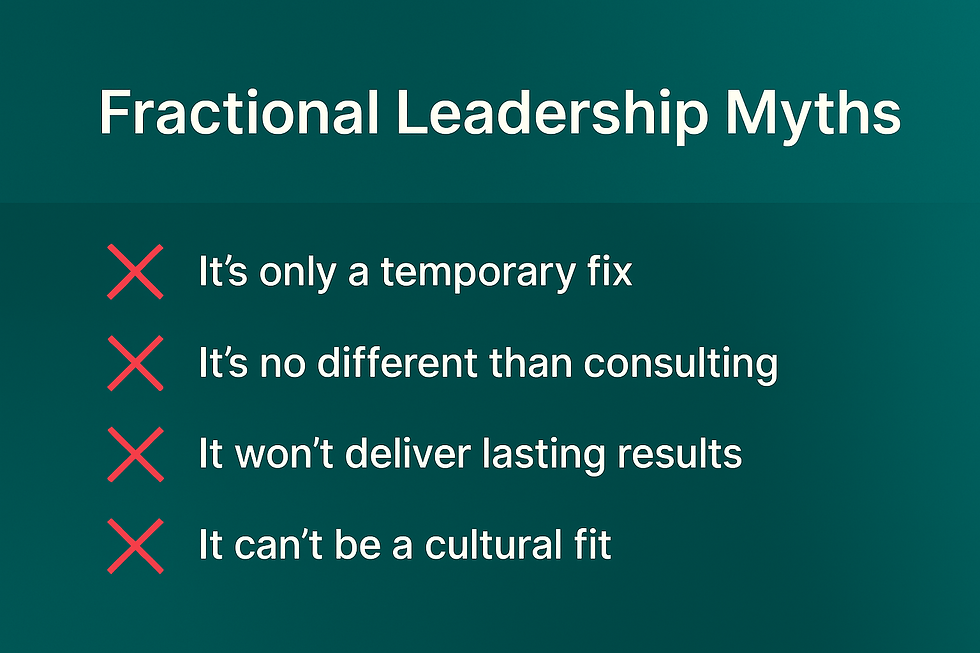
Fractional leadership is gaining momentum—with over 110,000 LinkedIn profiles now referencing it, up from just 2,000 in 2022—but a few persistent myths still prevent companies from fully embracing it.
Let’s clear them up.
❌ “It’s just consulting with a different title.”
✅ The difference is execution.
Consultants offer insight from the outside. Fractional leaders embed in the business. They assume ownership of outcomes and work cross-functionally to make strategy real.
In conversations with clients and prospects, one consistent theme has emerged: dissatisfaction with consultants who failed to truly understand and integrate into their business.
“They gave us smart ideas—but we needed someone who could get below the 50,000-foot view and actually connect the ideas to our organization and move things forward with our team.”
This distinction drives results. According to a study by FPG, 59% of businesses report improved strategic thinking and decision-making when a fractional leader is at the helm. Even Fortune 500 companies are turning to fractional roles—not as a stopgap, but as a strategic advantage.
❌ “Fractional leaders won’t care as much as full-time ones.”
✅ They often care more—because their value is tied to outcomes, not hours.
Fractional leaders are brought in to solve high-impact problems, fast. Their focus isn’t diluted across internal politics or slow-moving agendas. Instead of getting caught in the churn of status meetings or internal posturing, they stay centered on what matters most—moving priorities forward.
Because their engagement is outcome-driven, they naturally focus on clarity, execution, and momentum over noise, bureaucracy, or busywork.
But what makes this work isn’t just operational—it’s cultural. The best fractional leaders adapt to the rhythms, language, and values of the teams they serve. They build trust fast because they show up aligned—not just to outcomes, but to how your business operates and what your people care about.
That’s why nearly 80% of companies using fractional leaders report stronger alignment with their company culture (FPG).
❌ “Hiring full-time is the only serious way to scale.”
✅ Speed, focus, and traction matter more than headcount.
Hiring a full-time executive is ideal—but often not practical. Between recruiting, salary requirements, and ramp-up time, it can take 6+ months to fill a role. Momentum stalls. Opportunities pass.
Fractional leaders step in within weeks, stabilize performance, and create movement. And unlike traditional hires, their impact isn’t measured in hours—it’s measured in outcomes.
Time doesn’t equal traction. It’s what you do with the time that counts.
That’s why 35% of Fortune 500 companies use fractional leadership—and why companies adopting this model have reduced sales department costs by an average of 33% (ZRG + FPG).
When urgency matters more than optics, and progress is better than perfection, a high-impact fractional leader can do more in 90 days than some full-time execs do in a year.
When Does Fractional Leadership Work Best?
When execution is stuck between strategy and results
When founders or senior teams are stretched thin
When speed, clarity, and accountability are more important than headcount
At Renovant Partners, we help businesses clarify the right strategies—then embed leadership to execute with focus and momentum.
Looking for more information? Explore some of our other thoughts on the topic:
What do you think? Have you seen the difference between consulting, coaching, and fractional leadership in your own org?


Comments